
Coordinating Traffic Control for Concrete Deliveries on Urban Construction Sites
Coordinate concrete deliveries at urban construction sites with a practical traffic-control brief covering truck access, arrival changes and pedestrian routes.
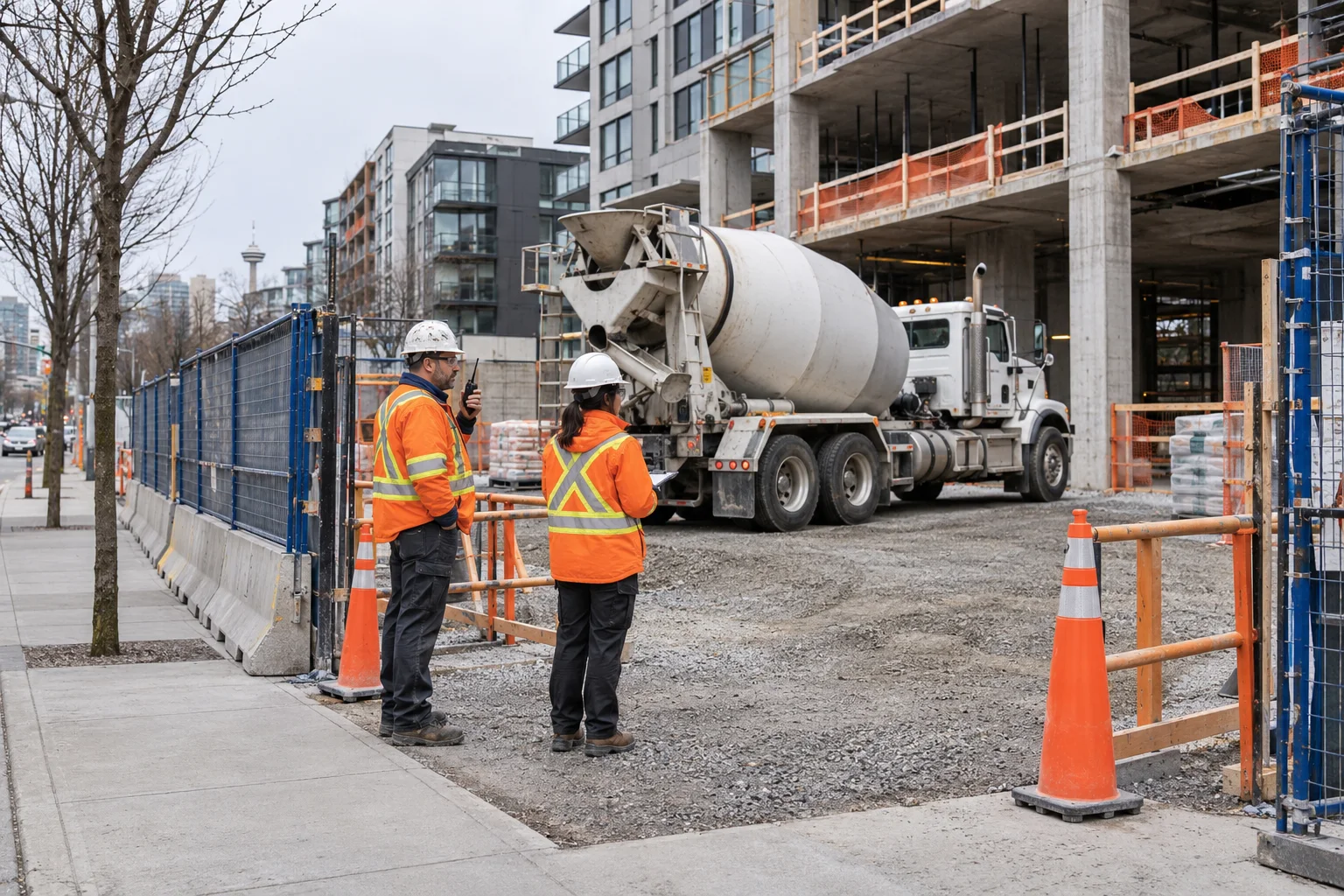
Coordinating Traffic Control for Concrete Deliveries on Urban Construction Sites
Concrete deliveries can place several demands on an urban site entrance at once. A mixer needs an agreed route, the site needs to be ready to receive it and nearby road users still need to move safely. When the first arrival is delayed or a gate becomes unavailable, the traffic arrangements need a clear decision process.
Traffic control for concrete deliveries should be coordinated with the construction team and supplier before trucks are dispatched. Safeside's role is the temporary traffic-control scope. The contractor and concrete supplier remain responsible for the pour, material requirements and construction operations.
Map the delivery movement before discussing arrival times
Start with where the vehicle enters, where it will stop within the site and how it will leave. Identify the gate, available site space and any movement that affects a sidewalk, cycle route or public travel lane.
Ask the supplier for the vehicle information the planning team needs. Different vehicle sizes or access requirements should not be treated as interchangeable. If the proposed route depends on a particular gate remaining open, make that dependency visible to the people scheduling the work.
For example, a truck that can enter through a wide site access may not be able to use an alternative entrance after another trade occupies the area. Resolve that issue before a driver arrives.
Give the traffic-control provider a delivery brief
A clear brief helps the team review the actual site activity rather than price an undefined request to "watch the trucks."
Include:
- The site address, gate location and current traffic-control plan.
- Proposed delivery dates, working hours and arrival sequence.
- Vehicle types and supplier contact details.
- Expected public-road, sidewalk or cycle-route impacts.
- The contractor's receiving contact and authority to change the sequence.
- Known permit conditions and any approval still outstanding.
Discuss this information with the team arranging traffic control services. If the scope includes a lane closure, review that requirement explicitly instead of assuming it is part of every delivery booking.
Keep the sidewalk and gate decision connected
An entrance is a shared point between the public route and the construction site. The plan should address how pedestrian and vehicle movements are managed there, including when a delivery is paused or the receiving area is not ready.
Discuss how visitors, people using mobility aids and cyclists will understand the arrangement. Do not assume that someone unfamiliar with the site knows where a truck is heading or which entrance remains open.
The appropriate field controls should come from the site-specific planning process. This article does not establish where personnel or devices should be placed, and it does not replace the contractor's vehicle-movement procedures.
Decide what happens when arrivals change
Delivery times can change. Before work begins, establish who will communicate an early or delayed arrival, who decides whether the site can receive it and what the supplier should do if access is unavailable.
Avoid using a public lane as an improvised waiting area. Any holding or stopping arrangement affecting public space should be considered through the relevant planning and approval process.
A useful escalation message is specific: which vehicle is affected, its revised arrival estimate, the access problem and the decision required. It gives the receiving supervisor and traffic-control contact something they can act on together.
Check the approved scope against the delivery day
The City of Vancouver's traffic-management process is relevant where construction activities affect public transportation facilities. Confirm the applicable road authority and approval requirements for the actual location.
Compare the current plan with the delivery arrangement before the shift. Has the work footprint changed? Are the approved hours still suitable? Has a different gate or vehicle movement been introduced?
If the existing arrangement does not cover the proposed activity, refer it for review. A truck booking or a traffic-control crew booking does not authorize an additional lane closure.
Close the loop after the last delivery
Agree who confirms that delivery-related traffic arrangements are no longer needed and who checks the condition of the affected access. If other work continues, distinguish the end of the concrete deliveries from the end of the overall closure.
Pass any unresolved access issue to the next supervisor or shift contact. A short record of what changed also helps the team prepare for a later delivery day without repeating the same assumptions.
Concrete delivery traffic-control FAQs
Does every concrete delivery require a lane closure?
No universal answer applies. The vehicle movement, site space and effect on road users need to be reviewed for the location.
Can Safeside organize the concrete pour?
Safeside provides traffic-control and planning services. Coordinate the concrete supply and construction activity with the responsible contractor and supplier.
What if the receiving gate changes?
Raise the change before sending trucks to the alternative entrance. The new route may affect the current plan, access arrangements or approvals.
Coordinate your next delivery with Safeside
Send the Metro Vancouver site location, proposed delivery schedule, access details and current plan. Call 778-200-7154 or request a free quote from Safeside to discuss the traffic-control personnel and planning scope for your project.